EU Stock Β· B2B only Β· 27 member states Β· FDCM E-Commerce S.A.
ENDEPL
Egg White Powder Β· EU Stock Β· B2B from 20 kg

Egg White Powder
& Whole Egg Powder
EU Bulk Wholesale

Pasteurised egg albumen powder and whole egg powder in pellet from EU-audited supply chains. Foam stability, heat coagulation, emulsification β€” full functional specification with CoA per batch. From 20 kg, DSV delivery to all 27 EU member states.

20 kg
min. order
β‰₯80%
protein ds (albumen)
Pasteurised
Salmonella-free
CoA
per batch
Egg Albumen Powder BULK
Protein (ds)β‰₯ 80%
Moisture≀ 9%
Fat≀ 0.5%
Ash≀ 8%
pH6.5 – 8.5
SalmonellaAbsent / 25 g
Whipping time≀ 5 min (standard)
AppearanceWhite/cream powder
from€41.78/20 kg
Order Egg Albumen β†’
Whole Egg Powder in Pellet BULK
Protein (ds)β‰₯ 45%
Fat (ds)β‰₯ 36%
Moisture≀ 5%
Ash≀ 4%
pH7.0 – 8.0
SalmonellaAbsent / 25 g
FormPellet (heat-stable)
AppearanceYellow/tan pellet
from€31.37/1 kg
Order Whole Egg β†’
Pasteurised β€” Salmonella absent/25g
CoA per batch included
EU Reg. 853/2004 compliant
DSV EU-27 road freight
From 20 kg β€” no framework contract
Product Overview

Egg albumen vs whole egg powder β€” composition and function

Egg albumen powder (dried egg white) is produced by spray-drying the liquid white fraction of chicken eggs after pasteurisation. The primary functional proteins are ovalbumin (~54% of total protein), ovotransferrin (~12%), ovomucoid (~11%) and lysozyme (~3.5%). These proteins are responsible for the distinct techno-functional properties of egg white: foam formation and stability, heat-induced gel formation, and water-binding capacity.

The protein content of egg albumen powder on a dry basis is β‰₯80%, with fat ≀0.5% β€” making it a high-protein, virtually fat-free ingredient. This is relevant for protein-fortified and lean-label formulations where WPI or egg albumen are competing options. At equivalent protein content, egg albumen provides superior foam stability and stronger heat-set gels than whey protein β€” due to the mixed protein system and the role of ovomucoid in foam stabilisation.

Whole egg powder in pellet contains both the white and yolk fractions, spray-dried and formed into pellets for improved handling and reduced dust. Fat content β‰₯36% ds (from the yolk lecithin and lipid fraction) gives whole egg powder its emulsification and enrichment properties. The pellet form is heat-stable and particularly suited for processed food applications where direct handling of powder is impractical. Whole egg powder is used as a direct substitute for fresh eggs in bakery, pasta production, sauces and ready meals at a substitution ratio of approximately 1 whole egg = 35–40 g whole egg powder + 35 ml water.

Both products are compliant with EU Regulation (EC) 853/2004 on hygiene for foods of animal origin, and EU Commission Regulation (EC) 1234/2007 (now Reg. 2013/1308) on egg marketing standards. Salmonella absent per 25 g and Listeria monocytogenes absent per 25 g are standard microbiological specifications confirmed per CoA batch.
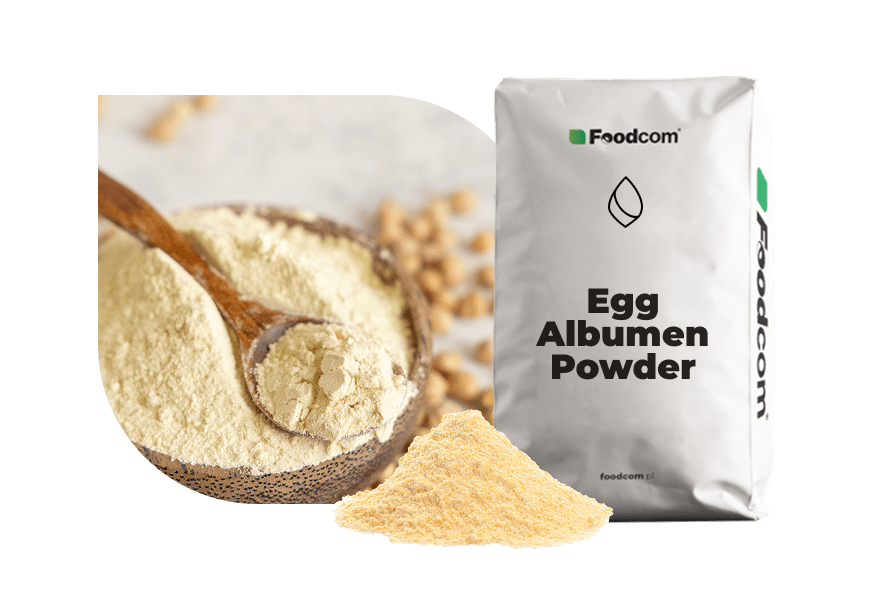
Protein (dry basis)β‰₯ 80%
Fat (dry basis)≀ 0.5%
Moisture≀ 9%
Ash (dry basis)≀ 8%
pH (10% sol.)6.5 – 8.5
Whipping time≀ 5 min (100 g/l)
Foam stabilityβ‰₯ 80% at 30 min
Gel strengthStrong heat-set gel
TPC≀ 10,000 cfu/g
Coliforms≀ 10 cfu/g
SalmonellaAbsent / 25 g
Listeria monocytogenesAbsent / 25 g
AllergenEGG β€” declared
Packaging20 kg paper bag
StorageCool, dry, <25Β°C Β· Shelf life 24 months
Protein (dry basis)β‰₯ 45%
Fat (dry basis)β‰₯ 36%
Moisture≀ 5%
Ash (dry basis)≀ 4%
pH (10% sol.)7.0 – 8.0
FormPellet
Substitution ratio~35–40 g + 35 ml water = 1 egg
EmulsificationHigh β€” lecithin-rich
TPC≀ 10,000 cfu/g
Coliforms≀ 10 cfu/g
SalmonellaAbsent / 25 g
Listeria monocytogenesAbsent / 25 g
AllergenEGG β€” declared
PackagingBulk bag / carton
StorageCool, dry, <25Β°C Β· Shelf life 24 months
Functional Properties

What egg albumen powder does in food systems

Egg albumen is one of the most functionally versatile food proteins. The four key functions below determine which production segment it is used in and why it cannot be simply replaced by whey or soy protein.

🫧

Foam Formation & Stability

Aeration Β· Meringue Β· Mousse

Ovalbumin and ovomucoid partially denature at the air–water interface, forming a stable protein film around air bubbles. This is the mechanism behind meringue, angel food cake, soufflΓ© and mousse structure. Whipping time for egg albumen powder at 100 g/l is typically ≀5 minutes; foam volume is 500–700% overrun.

Whipping time≀ 5 min (100 g/l)
Foam overrun500–700%
Foam stabilityβ‰₯ 80% at 30 min
Key proteinOvalbumin + Ovomucoid
🧱

Heat-Set Gel Formation

Coagulation Β· Binding Β· Structure

When heated above 60Β°C, ovalbumin denatures and forms irreversible covalent cross-links, creating a firm, elastic gel. This is the basis for coagulation in baked goods, protein bar binding, processed meat analogues and pharmaceutical tablet binding. The gel is firm, clear and shear-stable.

Coagulation onset~60Β°C (ovalbumin)
Full gel set75–80Β°C
Gel characterFirm, elastic, irreversible
ApplicationBars, bakery, meat analogues
πŸ’§

Water Binding & Moisture Retention

Texture Β· Shelf life Β· Yield

The polar amino acid residues in egg white proteins bind water effectively, improving moisture retention in baked goods and extending shelf life. Water absorption of egg albumen powder is approximately 4–5Γ— its own weight. This reduces syneresis in gels and improves texture in high-moisture products.

Water absorption4–5Γ— weight
EffectMoisture retention, reduced syneresis
BenefitExtended shelf life, yield increase
ApplicationBakery, meat, dairy analogues
πŸ”¬

Emulsification (Whole Egg)

Lecithin Β· Yolk Β· Sauce

Egg yolk lecithin (phosphatidylcholine) is one of the most effective natural emulsifiers in food. In whole egg powder, the lecithin content from the yolk fraction provides emulsification capacity for fat-in-water emulsions in mayonnaise, sauces, pasta dough and ready meals. The amphiphilic lecithin molecule stabilises the oil–water interface.

Lecithin sourceEgg yolk phospholipids
Emulsion typeO/W (oil-in-water)
Key applicationMayonnaise, sauces, pasta
FormWhole egg powder (pellet)
🍳

Colouring & Flavour (Whole Egg)

Carotenoids Β· Maillard Β· Yolk

Whole egg powder contributes the characteristic yellow colour from yolk carotenoids (lutein, zeaxanthin) to baked goods, pasta and custards. The yolk fraction also contributes flavour complexity through Maillard reaction precursors. These properties are absent in egg albumen powder, which is essentially neutral in colour and flavour.

Colour contributionYellow (carotenoids)
FlavourYolk richness
Maillard precursorsYes β€” reducing sugars + amino acids
ApplicationPasta, custard, brioche
🌑️

Heat Stability (Pellet Form)

Processing Β· Extrusion Β· Baking

The whole egg powder in pellet form is specifically processed to be heat-stable during handling and industrial processing β€” it does not clump, bridge or denature prematurely in dry-blending or extrusion pre-mixes. The pellet form eliminates the dustiness of fine powder and improves dosing accuracy in automated production lines.

Form advantageHeat-stable, no clumping
DosingAccurate β€” pellet flow
Process suitabilityDry-blending, extrusion
ReconstitutionFull on rehydration
Product Comparison

Egg Albumen Powder vs Whole Egg Powder β€” key parameters

Choose the correct product based on the required functionality. Albumen for foam and lean protein; whole egg for emulsification, colour and full egg replacement.

ParameterEgg Albumen PowderWhole Egg Powder (Pellet)
Protein (ds)β‰₯ 80%β‰₯ 45%
Fat (ds)≀ 0.5%β‰₯ 36%
Moisture≀ 9%≀ 5%
FormFine white powderYellow/tan pellet
Min. order20 kg1 kg
Price / pkgfrom €41.78/20 kgfrom €31.37/1 kg
Foam formationExcellentModerate
Heat-set gelStrong, firm, clearSoft-medium, opaque
EmulsificationLow (no yolk)High (lecithin-rich)
Colour contributionNone (white/neutral)Yellow (carotenoids)
FlavourNeutralRich egg flavour
Water bindingHighModerate
Substitution ratioN/A (white only)~35–40 g + 35 ml water = 1 egg
Primary usesMeringue, foam, bars, GF breadBakery, pasta, sauces, ready meals
AllergenEGGEGG
SalmonellaAbsent / 25 gAbsent / 25 g
EU Reg. 853/2004CompliantCompliant
Applications

Where egg powder is used in food manufacturing

Application selection is function-driven. Egg albumen is not interchangeable with whole egg powder β€” they provide different functionality. Select based on the required techno-functional property, not on generic 'egg content'.

πŸŽ‚
Egg Albumen

Meringue, Angel Cake & SoufflΓ©

Egg albumen powder is the only viable industrial raw material for large-scale meringue and angel food cake production. The foam stability provided by ovalbumin and ovomucoid cannot be replicated by whey or plant proteins at equivalent dosage. Standard dosage: 30–50 g egg albumen powder + 250 ml water per 8 egg whites.

🍞
Egg Albumen

Gluten-Free Bread & Bakery

Egg albumen powder provides structure, moisture retention and protein enrichment in gluten-free formulations. The heat-set gel network contributes to crumb cohesion. It is frequently combined with psyllium husk or xanthan gum for complete gluten-free structure.

πŸ’ͺ
Egg Albumen

Protein Bars & Supplements

Egg albumen is used as a binding and structuring protein in protein bars, providing heat-set cohesion without the moisture sensitivity of whey protein. It is also used as a protein source in supplement blends for its complete amino acid profile and high biological value.

🍝
Whole Egg

Pasta, Noodles & Dough

Whole egg powder replaces fresh eggs in pasta production at 35–40 g per egg equivalent. The yolk lecithin provides dough plasticity and the protein fraction contributes to the characteristic golden colour and texture of egg pasta.

πŸ₯—
Whole Egg

Sauces, Dressings & Mayonnaise

Whole egg powder provides emulsification for fat-in-water emulsions in industrial sauce and dressing production. The lecithin content stabilises the oil–water interface. At 5–10% whole egg powder in the formulation, emulsion stability equivalent to fresh egg is achieved.

🍳
Whole Egg

Ready Meals & Egg Dishes

Whole egg powder is used in scrambled egg products, omelette mixes, quiche fillings and ready meal egg components where fresh shell eggs are impractical. The pellet form allows accurate dosing in automated production lines.

Rehydration Guide

Reconstituting egg powder for food production

Correct rehydration is critical for foam performance (albumen) and emulsification (whole egg). Incorrect temperature or water ratio reduces functional yield.

πŸ₯š
For foam / meringue / bakery use

Egg Albumen Powder

1
Use cold water
Rehydrate in cold water (8–12Β°C) for foam applications. Warm water pre-denatures proteins and reduces foam yield.
2
Ratio: 1:8 (albumen:water)
100 g egg albumen powder + 800 ml water = equivalent to approx. 8 egg whites. Adjust based on target Brix.
3
Allow hydration time
Allow 30–60 minutes cold rehydration before whipping. Rushing reduces foam stability by 15–25%.
4
Whip at medium speed
Use a planetary mixer at medium speed (60–80 rpm) until stiff peaks form (typically 4–6 min).
5
Cream of tartar (optional)
Add 0.5–1 g cream of tartar per 100 g powder to stabilise foam at lower pH. Improves heat stability in meringue.
🍳
For full egg replacement

Whole Egg Powder (Pellet)

1
Use warm water
Rehydrate whole egg powder in warm water (40–50Β°C) for faster reconstitution and better emulsification.
2
Ratio: 35–40 g + 35 ml water = 1 egg
Mix 35–40 g whole egg powder with 35 ml warm water to replace one medium egg (~55 g). Adjust for recipe needs.
3
Stir, then rest
Stir until homogeneous, then allow 5–10 min rest for full hydration of the pellets before incorporating into the recipe.
4
Use immediately after mixing
Reconstituted whole egg powder deteriorates faster than fresh egg. Use within 2–4 hours of reconstitution (refrigerated).
Why FDCM

Egg powder from EU stock β€” B2B from 20 kg

FDCM supplies food manufacturers, bakeries, protein supplement producers and industrial kitchens across the EU. No annual commitment, full documentation.

πŸ₯š

From 20 kg

Egg albumen from 20 kg, whole egg from 1 kg. No framework contract. Scale from trial batch to production pallet.

πŸ“‹

Full documentation

CoA per batch β€” protein, fat, moisture, ash, pH, TPC, coliforms, Salmonella, Listeria. Allergen declaration (EGG), EU Reg. 853/2004 compliance. All at no charge.

πŸš›

EU-27 delivery

DSV road freight to all 27 EU member states. Standard 3–7 business days. Groupage and pallet delivery. Full shipment tracking.

βœ…

Pasteurised & compliant

All egg products are pasteurised β€” Salmonella absent per 25 g as standard. EU Regulation (EC) 853/2004 on hygiene for food of animal origin confirmed per shipment.

FAQ

Frequently Asked Questions β€” Egg Powder

Yes β€” all egg albumen powder supplied by FDCM is produced from pasteurised liquid egg white. Pasteurisation (typically 56–60Β°C for a defined hold time) eliminates Salmonella without significantly denaturing the functional proteins. The CoA per batch confirms Salmonella absent per 25 g and Listeria monocytogenes absent per 25 g. EU Regulation (EC) 853/2004 compliance is confirmed per shipment.
The standard substitution ratio for whole egg powder is approximately 35–40 g of whole egg powder + 35 ml of water to replace one medium shell egg (approximately 55 g in-shell, 50 g liquid). The exact ratio should be adjusted for recipe-specific moisture and protein requirements. For albumen powder, the substitution for egg whites is approximately 12–15 g of egg albumen powder + 100 ml water to replace one egg white (~33 g liquid white).
Egg albumen produces more stable foams than whey protein for two reasons: (1) Ovomucoid (11% of egg white protein) is a heat-stable glycoprotein that reinforces the air–water interface film and resists drainage, while whey proteins lack an equivalent stabiliser. (2) Ovalbumin (54%) partially denatures at the interface at room temperature without full heat denaturation, forming a stronger initial film. Whey proteins are effective foaming agents but foam stability at >15 min is significantly lower than egg albumen at equivalent protein concentration.
Haugh Unit (HU) is a freshness measurement for shell eggs β€” it measures albumen height relative to egg weight and indicates protein integrity. HU is not directly applicable to spray-dried egg powder since the drying process is assessed by protein content, whipping time and foam stability rather than HU. For egg powder, the relevant functional quality parameters are: whipping time (≀5 min at 100 g/l), foam stability (β‰₯80% at 30 min), protein content (β‰₯80% ds) and moisture (≀9%).
Yes β€” egg albumen powder is widely used in gluten-free bakery. It provides protein structure (heat-set gel network) and aeration that partially compensates for the absence of gluten. Typical usage is 3–8% of flour weight. For optimal results, it is combined with a hydrocolloid (psyllium husk, xanthan gum or HPMC) which provides the viscous network that egg albumen cannot build alone. Egg albumen powder is not gluten-free by certification β€” it is naturally gluten-absent, but it should be tested if the product requires a gluten-free label claim.
Key EU regulations for egg and egg products: EU Reg. (EC) 853/2004 β€” hygiene rules for food of animal origin (applies to pasteurised liquid egg and dried egg products); EU Commission Reg. (EU) 589/2008 β€” marketing standards for eggs and egg products; EU Reg. (EU) 1169/2011 β€” EGG must be declared as an allergen in the ingredients list and ingredient information. All FDCM egg products are compliant with these regulations. Documentation available per batch on request.
Egg albumen powder: minimum 20 kg (one bag). Whole egg powder in pellet: minimum 1 kg. For in-stock products, order-to-dispatch is typically 1–2 business days. EU delivery via DSV is 3–7 business days. No framework contract or annual volume commitment required.
Standard: CoA per batch (protein, fat, moisture, ash, pH, TPC, coliforms, Salmonella, Listeria). Available on request at no charge: TDS, allergen declaration (EGG), non-GMO statement, EU Reg. 853/2004 compliance statement, FSSC 22000/BRC supply chain certificate, country of origin.
Contact & Ordering

Request Samples, Specifications or a Quote

We respond to all B2B inquiries within 4 business hours

Operated by

FDCM E-COMMERCE SPOLKA AKCYJNA
Krzysztofa Komedy 2/3
02-517 Warszawa, Poland
VAT: PL5214100463

Contact

contact@fdcm.eu

fdcm.eu β€” full catalogue & online ordering

EU Delivery

DSV road freight Β· 3–7 business days
All 27 EU member states
View delivery options β†’

Ready to source egg white powder from EU stock?

Egg albumen powder from 20 kg and whole egg powder from 1 kg β€” live pricing, CoA documentation and online ordering on FDCM.eu. No framework contract.